Saturday, 8 October 2011

Auschwitz-Birkenau

When I was a teenager I became friendly with an aging Polish woman called Sophie Sydow. She mentored me through my musical listening and we spent hours, at the record shop she managed, her getting me to try recordings, explore music, gain some kind of critical standards and telling me a great deal about life in Poland before and during WWII.

It was a pretty tragic tale. Her father had been a diplomat. He simply disappeared. A week later her sister was raped and murdered and her brother hung himself in the nearby woods, Sophie found the body. Other relatives were bundled off into concentration camps. She met up with her husband Matt and supported him in the Polish Resistance. Later they came to the UK to escape communism and lived a quiet life looking after stray animals, on a fairly epic scale.

But even in the 1970s life provided new tragedy. Her only child, Nina, was murdered in Greece. Assaulted and left face down in a puddle the girl drowned. Sophie spent much money and ended up losing her job while she travelled back and forth to challenge the lack of outcome from the investigations of the Greek authorities. She died of heart disease, a heart-sick woman in many ways. Matt lived on for about 15 years looking after the animals.

Her story pervaded my impressions of Poland, once a wonderful country, hugely depleted by the nazi invasion, then communist suppression.

I thought about her when we were in Krakow, though her family was from Warsaw. I thought about her when we visited Auschwitz-Birkenau.

~~~~~~~~~~~~~~~~~~~~~~~~~~~~~~~~~~~~~~~~~~~~~~~~~~~

What are visitors up to when they come here? The Second World War finished 66 years ago. The oldest people I saw there would have been children then, but could well have gone to remember relatives of an earlier generation. One or two quite young Jewish men were clearly distressed. Some people came to make commemoration.

But how about all of us who are tourists? Those of us who have no known connection to the people who perished there. We variously went to the salt mines, we climbed up to the castle at Krakow, we took a bus trip to the concentration camp.

Before we went I was very ambivalent about this trip. My wife was intent upon it and fine about going alone. I had been told it was tidy, clean and there were nice trees all around. Of course, it had to be sanitised for so many reasons, but I did not like the hint of theme park that was suggested by more than one person.

We did both however go. Facilely I wondered what the weather would be like. Surely, it at least ought to be raining. Sunshine would be inappropriate; despite it being obvious that there would have been normal weather in the area when it was full of prisoners. Somehow, I imagine it to exist in a black and white world of wartime film.

It was sunny. Despite this, there was plenty to make one go cold if not actually numb. We thought that we had a reasonable grip on what had happened and why; no, our knowledge was half digested, barely half remembered.

The journey out from Krakow takes about an hour and a half. On the bus there were about 25 people, one retired couple, us and then the next oldest would be about 30. Three young twenties females sat near us and were intent on phone swapping last night's drinking photos. But the organisers had other ideas and a documentary film was put onto the system. The group fell silent.

These two camps were liberated by the Russians. The film was shot by a cameraman who, 40 years later, explained the circumstances; one of which was that at the liberation the inmates were frightened and traumatised. There was no joy and there were no smiling faces. In an attempt to provide more appropriate propaganda; months later some former prisoners were coaxed to return and seemingly burst out of their prison as the Russians arrived; joy unconfined and these remnants strode cheerily in front of the camera, waving, smiling and well dressed.

Some kind of sense prevailed and the reconstructions were never used. The film was silent about the Russians basically moving a number of prisoners to Russian work-camps. Silence also prevailed on the bus from the start of the film until we arrived at Auschwitz. A kind of preparation for the visit had taken place.

The names of the camps were Germanised versions of the local Polish place names.  Auschwitz was the first camp. As such, its design was not up to the Final Solution in its comparitave lack of factory efficiency. The gas chamber could only accommodate around 250 killings at a time and darn it, the warehouses storing the possessions of the victims was an inconvienient distance from the railway. Auschwitz had been set up primarily as a labour camp. So, once the trawling in of the Jews, Gypsies, Political Prisoners, Homosexuals and general undesirables became a Europe Wide policy for the nazis, the nearby Birkenau was set up on a staggering scale as part slave camp, part killing ground.

By January of 1945 it became clear that the Germans would lose the war and in preparation for withdrawal there was a half hearted attempt to dispose of evidence by blowing up the underground gas chambers in Birkenau and march off the prisoners who were deemed possibly useful. On the vast site only around 5,000 survivors remained to be rescued.

Birkenau was a kind of model camp and over 30 others were built in Upper Silesia.


~~~~~~~~~~~~~~~~~~~~~~~~~~~~~~~~~~~~~~~~~~~

We encountered our guide at the entry to Auschwitz. We were given headphones and a receiver. The guide confided the facts and figures as though just to each individual, like a voice inside your head. Even when in another room, she spoke directly into my ear. She was short, red haired, in her late 40s and with a deep gravel voice. Her delivery was succinct, low key, but exceptionally powerful. Throughout the entire three hours, the words 'German' and 'Germany' never passed the lips of the guide. Auschwitz had been staffed only by SS and reference made to nazis. German visitors are allowed the dignity of being distanced from the perpetrators. Rather more dignity than was allowed to the more than 1,000,000 people who died within the two camps.

Currently I am re-reading Upton Sinclair's 'The Jungle'. It tells the story of the Chicago stockyards at the turn from the 19th Century to 20th. Eastern European immigrants were exploited there and the ever innovative factory owners boasted of a system utilising every part of a pig except its squeak. Bones became fertiliser or buttons or combs, hides made into all sorts; the meat itself vital, but by no means the sole product. The meat-packer owners set up adjacent soap and glue factories. The area became ultra efficient at making money for the rich; and notorious for the way the health of the workers was carelessly damaged. Like Dickens before him, Sinclair exposed to the world unethical methods of production and the outrage effected some changes of law to lighten the lives of those blighted by the system.

All of that factory efficiency and ingenuity in the use for any part of the animal came to mind during the tour of the prison camps. The first thing to go was your dignity. 70 people in a rail truck with only a bucket as a toilet and transported up to 2000 kms from as far as Greece or Norway. Lack of privacy across perhaps 10 days, lack of food or water; living amongst those who died all added to the great heat or extreme cold to produce an initial filter for those too old, young or weak to survive the conditions of the journey. 

At journey end those stumbling out of the trucks were lined up and men were separated from women. Their 25 kilos per head of luggage was left on the platform to be stored in warehouses once the contents were sorted. Those deemed strong were marched off to the work camp, the others 'cleaned' up, hair chopped off, clothes removed and then driven into the gas chamber, then dragged to the ovens.

The nazi's were big on admin, so notated in detail the millions of dresses, coats, shoes, suits, pairs of glasses and artificial limbs confiscated to be sold to the citizens back in Germany. Hair was all treated to make clean it and bailed like hay. It was then woven into fabric, socks for submariners, blankets. Gold was pulled out of the teeth of the dead. After a while, the water sources now grey and clogged with human ashes, they spread new ashes across the nearby fields as fertiliser. After the war the collected hair was chemically tested as it was uniformly grey, it bore traces of Zyklone B, despite it having been removed prior to death. The air outside the chambers must have been invaded by small penetrations of it.

Gypsies, twins and any other people deemed of interest were experimented on in the hospital; Mengale who lead the work escaped a few days before the Russians arrived; he was never caught.

So, what were the ones who were chosen to work actually doing?

Once the much larger Birkenau was being built, many German factories were re-sited out of Germany into the area and contracts were set up between the industrialists and the camps for a continuous fresh supply of slave labour. Too many were dying merely of the long walks to the factories, thus mini camps sprung up around the furthest away ones.

IG Farben was one of the largest industrial companies in the world. It chose which factories it wanted to take over and to extend using slave labour on the building works and as workers in its chemical factories. It produced much of the Zyklon B that was used to kill its own slave labour. To date shares in the company continue to be traded; though it is in a continued state of liquidation with assets worth many millions of Euros.

A subsistence diet was provided. The accommodation was in crowded huts with poor heating and gaps between the top of the walls and the roof. The winter temperatures were similar out or in the huts. Going round and gazing at corridors of photographs of the inmates, each had three pieces of information, birth date, date of admission, date of death.

Even young and strong looking people, if they arrived in January, they would almost all be dead by March. The sole clothing; thin striped suits and clogs, was no defense against the cold. Brutality was a default setting. Minor infringements were met with various tortures or deprivations, including the 'four to a cell'. The cell being about the size of a telephone box; many suffocated from this treatment.

Many committed suicide by holding onto the electric wire fencing.

Those with the first 1000 numbers tattooed onto them often lasted the full five years. These initial inmates were the inside admin workers and escaped the worst privations of working outside each winter. First in and last out in a strange twist of fate.

The 'wall of death' in Auschwitz was where prisoners were shot, no one can even guess how many. Mobile gallows were trundled about and if any prisoner escaped, 10 were randomly chosen during roll call and hung in front of the assembly.

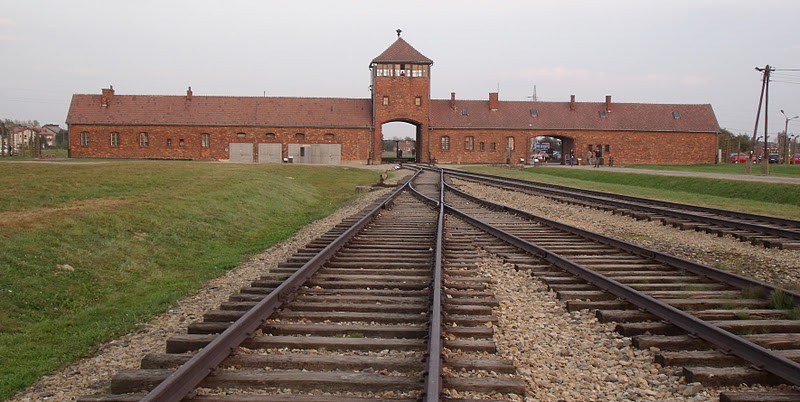
Over at Birkenau the railway tracks run the 1200 meters through the centre of the camp, dividing it; women's camp to one side of the track, mens' on the other. Half way along a wooden rail cattle-truck is sited to mark 'The Place of Choosing'. Here, as the people were disgorged, immediate decisions were taken by doctors. The doctor indicated with his thumb to left or to right, each was then consigned either to the gas chamber or to the work huts. Those to die were walked 600 meters to the new underground chambers to be gassed. 5000 could be disposed of a day, despite which, evidence emerged that the ovens could not cope and bodies were also burned in the ground around the gas chambers.

No one of us asked a single question. People were silent, absorbing, learning and of course, taking lots of photos. The ride back on the bus was quiet, not silent, but subdued. What got to me most was not the cells, not the gallows or the 'Wall of Death'. It was the tons of hair, thousands of spectacles. If you could not see, too bad, you were a kind of fodder now, not a person. Everything removed, people exploited to the uttermost, their very dust utilised by the Third Reich; deploying feelingless conveyor-belt methods. Treated like animals in the Chicago stockyards. Like animals.

What did I take away. At 58 is it yet possible to be disappointed and dispirited at the way we deal with one another? Yes.

Auschwitz:

 'Freedom Through Work'


       Hair


Birkenau


   The place of the choosing


No 1 underground gas chamber


For so very many; the end of the line


Saturday, 1 October 2011

Travel for Work Part 2

The point of this story is the occasional pointlessness of trying to economise.

On another trip to the north of where I live; I was to visit a business park on the outskirts of Preston. I changed trains there, but never strayed out of the station. If I have any say in it, I won't end up there again.....even to change trains. There might be the possibility of being stranded there and once bitten, I intend to avoid even the remotest risk of being bitten there again.

I joke with colleagues that I don't 'do' places that have less than two museums, an opera house and entries in the Good Food Guide. Of course, I go where I am sent, but on no level is Preston a place anyone other than the most thorough of visitors would want to visit and even the intrepid and completest kind of traveller is unlikely to return. The very nicest thing I can think of to describe it is, unlovely.

I travelled up the day before for an all day meeting with an earlyish start; for sure too early to allow me to get there on time that morning. On my economy  drive; I had a look at a map and decided I could walk, with luggage, to the hotel and save charging a taxi fare. Taxis generally make me very twitchy. No matter who is paying, I am constantly eyeing the meter and mentally urging lights to change so as not to rack up the total. The walk allowed me leisurely views of the filthy and dilapidated state of the town centre. Old buildings uncared for and newer ones of the stained concrete variety.

The hotel I had been put into was a Holiday Inn which delightfully faced the characteristically stained concrete bus station and multi story car park. I asked at the hotel how long a taxi ride was out to the Business Park I was going to the next morning. I was told it was at least 20 minutes. Ouch! I asked whether buses went there. Yes, a 41B, I was told what stop to go to....well, the 41B stop, but it was pointed out to me from the window.

Ever intent on punctuality I went to the station, confirmed that the route did indeed go to the Park and worked out the timing of the bus I needed.

So, in good time next morning I was walking towards the bus stop and could see it looked like a bus was about to draw away. It was a 41...not a 41B. But I had been throrough with the timetable the night before and the only bus due to draw away from this stop was the 41B. So, I got on and asked the driver if he was going to the business park....he just grunted, took the money I had in my hand and chunked the ticket and my change out of his machine.

I sat down and watched the world go by.......for about 25 minutes, then I started to get a bit concerned. I waited until we were at traffic lights, then went forward and asked the driver how far it would be to the Business Park. He just grunted, gave me a dirty look and turned back to watch the lights.

On the way back to my seat I asked the pensioners around me.....no passenger under about 70 other than me.....none of them had so much as heard of the Business Park. This bus terminated at Tesco supermarket. I complained that the driver had not only taken my fare when I asked if we were headed in my direction, but now refused to speak to me.

"Oh" said one of the passengers, " He is Polish and doesn't have one word of English."

I was pretty taken aback at this and although it explained the event, it did not explain to me why Preston would employ someone with NO English to do a job that needed some kind of communication skills beyond grunting. I also wondered at there being no test he would have to pass to read road signs and deal with any emergencies. It did make me wonder about how they recruited doctors for their hospital. I was having darker and darker thoughts about this town and the people in it who surely only remained because they were somehow stuck in the way flies get stuck to flypaper.

It seemed like a sensible thing to get to Tesco and no doubt there would be some taxis there. It was still a fair ride to the Supermarket, but I had 20 minutes left to the time of the appointment. Luckily I had allowed plenty of time. But my stress level was rising. I don't take it well if there is even a risk I am late for a meeting and in this instance I was going into a situation that needed some delicate handling.

At Tesco, I got off the bus, it scarpered and I could see there were no taxis. The upshot was I had to phone, apologise and have one sent by the people I was visiting. I was 30 minutes late for the appointment and the fare was almost exactly what I ended up paying to get back to the railway station to get home. My best laid plans had been a failure. I had ended up spending more than had I got a taxi from the hotel, and I arrived not just late, but at a disadvantage in the psychological negotiation stakes. I did not get out of the meeting all that I had intended. Economy is not always the best policy.

I swore never to darken the towels of Preston again.

Friday, 30 September 2011

Travel for work Part 1

Surely much more prosaic than foreign travel. Yes and no. I do go to a fair number of places in the UK all employer paid. With the state of finances generally this often prompts me to try and economise in various ways.

I often get home quite late in the evening because I can't make myself charge up £65 one way from London when I can wait another hour and do the same journey for £19. But I really don't like getting home at 8.45 in the evening. Last week I took that train it was 59 minutes late. At the preceding station it was logged at 61 minutes overdue and the passengers escaping there were told to get hold of compensation claims. But in the 15 minute ride on to my stop, they made up two minutes. So no compensation offers.

We are supposed to book our hotels through a booking agent; I am never convinced this saves money. Occasionally I visit a town that is not covered by the agent. One such was Wigan.

Now if you have heard legends of Wigan Pier; that does not actually indicate that it is on the coast. Sometimes I go to Southend on Sea; it is kind of by the sea, well up the estuary but it has a splendid pier and splendid views of an expanse of water. However Wigan is about 40 kms up the mouth of a river, no salty air here. The pier pokes out into that river.

I was meeting up with two of the team of writers that I work with and we were spending a couple of days together. One, Bev, comes from Wigan and we decided to meet up at her home town. I asked Bev for a recommendation for somewhere to stay. She surprised me by firmly suggesting a Wetherspoons pub with rooms. Wetherrooms.......I caviled. How about somewhere else? No, she knew people who had stayed there happily.

I was picked up at the station by the second writer, Lynda; she is a tonic to work with and sees the humour in every situation. We arrived at the pub which is on a main road and looking very careworn inside. It gives a very different impression from the current Laterooms entry. We walked through the bar that looked like herds of cattle had been scuffing the carpet with their hooves ever night for a year, I clocked the chipped woodwork.

But the reception guy was pleasant. As I always do, I asked for a quiet room. Duly noted. Lynda expressed no preferences.

Getting to my room I noticed a strong smell of damp. Looking out of the window I saw my room faced onto the main road. I gazed out glumly and had to concede it was not burdened with much traffic. A few minutes later I met up with Lynda in the bar. I mentioned my front of house view; this set her off in peals of laughter. She was tucked away right at the back of the building. She suggested that perhaps she would be woken up by the bins being collected and that was why I was not at the back.

Now we had arrived at an unfortunate time for Bev. Just that day her much loved and house trained, elderly pet rabbit had died. There had been many a rabbit trauma over the couple of years I had known Bev. I can be very stony hearted about pets. But I was sorry about the rabbit, though the upside was that luxury holidays would be possible now that the vet was not taking them out of the mind boggling bills Bev had been paying to keep the animal comfortable.

But Bev is a trooper and she had determined, bereavement or not, we three would meet up and have a night out. She appeared and asked if we wanted to eat at the pub. NO! I did not want to eat at the pub. I suggested it would be round to her house for rabbit pie......this could have been a tricky moment, but we ended up rocking with laughter as we imagined how to keep a bit of the pet as a memento. My risky approach had broken her mood and we decided to go to an Indian place for a meal.

We parked right outside, a rare event these days. The place was modern-bland, clean lines, cream walls. We sat down and unusually in an Indian we decided on a bottle of wine. We had the house white delivered. It was screw top and instead of offering anyone a taste, the waiter plonked the plonk into the glasses. We were chatting about how to sort out the work; I tasted the wine. It was vile, tasted of tin and was bitter. I said nothing and wondered what the others thought.

They were off into a plan for how we design the piece of writing we were considering, but I noticed that Bev was chatting and sipping and not falling over in shock. They breed tough girls in Wigan. Eventually I had another taste. It was every bit as bad as I had remembered. I asked how the wine was....the answers.....bogging, terrible. I called the waiter over. I said that we did not like the wine and would he please take it away and take it off the bill. He looked worried and disappeared.

We were left to our own devices for some time. In the interim, Bev was still holding the glass, chatting and taking tiny sips from it as though by reflex. Eventually the manager appeared.....he was clearly in no mood to pander to customers. I explained that we thought the wine was not drinkable, it was tinny, tasted awful and would he please take it back and take it off the bill.

He pointed at the half empty bottle and demanded. "Well if you did not like it, why did you drink so much of it?" I frowned and indicated that the wine from the bottle was sitting undrunk in the glasses. He then raised his voice and told me there was nothing wrong with the wine, could be nothing wrong. It was the house wine and popular. I told him I did not care how many bottles he sold, he was not selling one to me.

He then grabbed the bottle and then each of our glasses in turn and poured the wine back into the neck of the bottle. He then pointed to the fact that there was some wine missing. I was losing patience by now and just curtly told him that it had better not appear on the bill.

We then watched in amazement as he ceased the bottle top, screwed it back onto the bottle, stalked over to the bar and put the bottle behind the bar. His parting shot was a loudly muttered, "If you did not want to pay for it; you should not have drunk it."

It was clear that the wine was going to be sold by the glass with the added ingredient of our sputum and at a higher profit. This set us off in a combination of shock and amusement. We did consider disappearing and leaving him with an ordered meal, but we decided to stay put; we were hungry. I felt reassured that I had kept an eye on the manager to make sure he did not go near the kitchen; as I was not about to risk him adding his sputum or worse to our food. The food arrived and it seemed fine.

Back at the gracious Wetherspoons, things were in full swing; they sell it cheap and pack 'em in. We had a couple of bevies and Bev's sister arrived to give her a lift home. Somehow it seemed not in the least odd that Bev's sister had turned up dressed for bed, wearing her favourite teddy bear patterned pajamas and furry slippers.

The evening and an open window had not allowed dispersal of the damp smell from my room. I had earlier noticed there was no hot water....still none. I fell asleep and at what turned out to be 2am I was woken by a loud grinding noise, it certainly made me jump. I lay there exasperated having worked out exactly what it was. The draymen had arrived and were dragging the empty metal beer barrels across the cobbles in front of the pub and dragging full ones in. This lasted about 20 minutes.

Lynda had had a very peaceful night at the back of the building. She was sympathetic to my having to wash in cold water, but got me laughing yet again about the entire set-up.

Later when we met up with Bev we told her about the accommodation. "Well", says Bev, "next time you come there is a lovely sort of small mansion house hotel out near me and it is within the cost limit." Stunned I asked her why then she had stuffed us into the crappiest place in town. "Well, it was close to the office."

I said; "But Bev, we had Lynda's car!"

Saturday, 17 September 2011

Bremen: In the steps of Napoleon...again!


I am quite decided: sometime soon I am off to Vietnam. I know that Napoleon was never there, never annexed it, never plundered it. He did not make any of his relatives king, nor fought battles or took lovers there.

Although I know a fair bit of history, I had not known that the little emperor had at one time attached Bremen to his empire. I often feel I dog his steps, 200 years after he has passed through, left his footprints and grabbed his spoils from everywhere, Venice to Egypt, Naples to, well, Bremen!

Unusually for anywhere he 'visited', the furniture remains intact. I assume that by this time Paris was simply stuffed with artifacts and chairs and desks, sideboards and thrones from the various cultural centres of Europe. Even from the Vatican he purloined 100 art works to be dragged back to the Louvre: one reason for his excommunication. Though, making his new born son, Napoleon, king of Rome probably did not sit well with either Italian prelates or politicians.


What we see in Bremen is a well organised, prosperous city with a medieval centre and a great transport system. But not all is as it seems. During the 2nd world war the Allies flattened 40% of the city and 60% of its port. A lot has been restored to seem old, but some significant buildings escaped the raids. One such is the Rathaus, the town hall. Going round this on a guided tour is to join an exercise in the civic pride of heritage and in what the city has become.

This was one of the Hanseatic ports. A mercantile arrangement around the Baltic that was a distant precursor to the European Union. It lasted less than 100 years from the 1350s; but echoes of the arrangement continue even to this day.

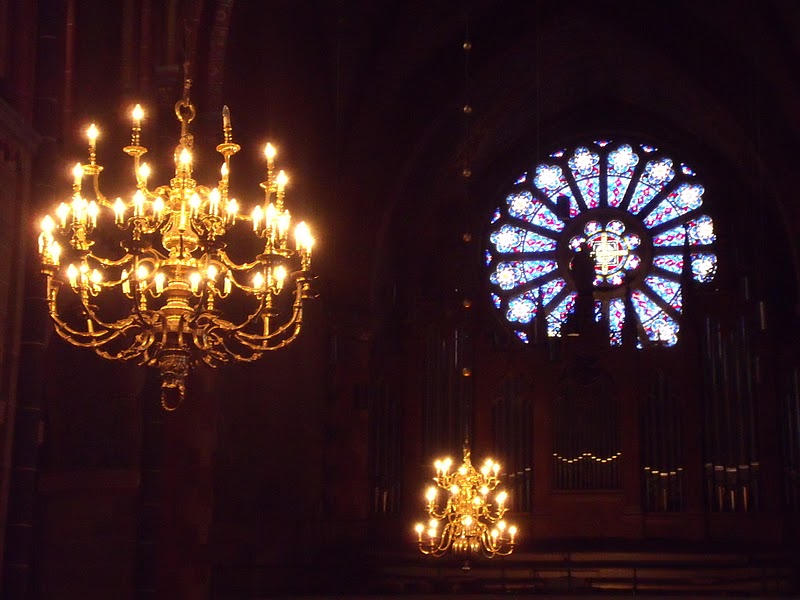
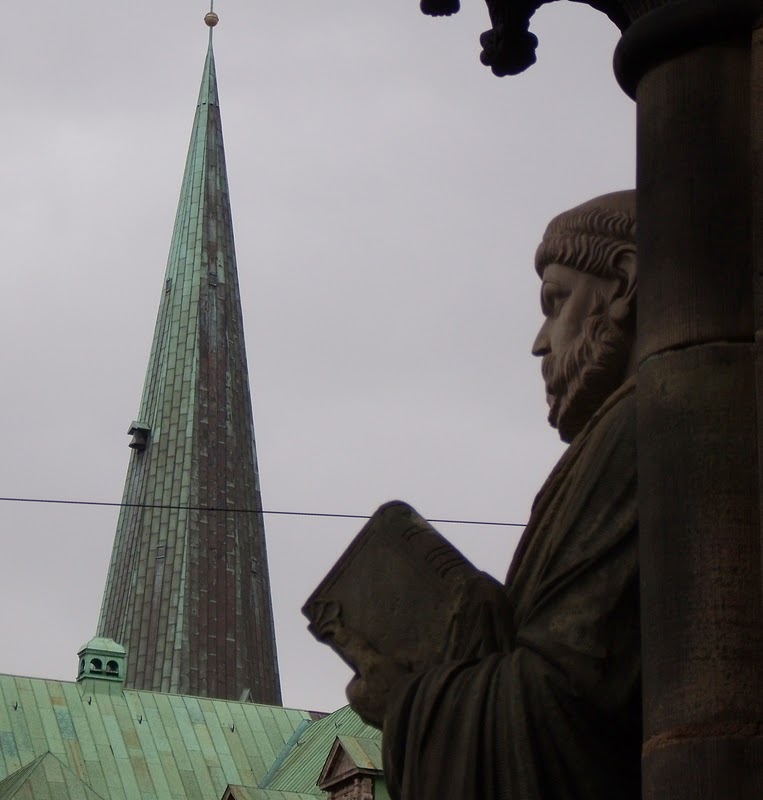
Subsequently there was a tussle between the Roman church and the Protestants, the latter of whom protested in the cathedral in favour of reformation sermons. The Archbishop promptly upped sticks and, locking the cathedral, it fell into disuse and disrepair. It was abandoned for many decades. Today walking into it the signs of reformation exceed mere removal of any signs of idolatry. The axis of the church has been changed, not just bringing the altar forward into the nave; but swiveling it so that where the altar would once have been is now an elevated seating area that looks onto the side of the altar.


 This break with Rome was the signal for local politicians to grasp power and set up their own government along ancient republican lines; with two 'mayors' holding their posts simultaneously, like tribunes in Rome. The idea was to prevent the concentration of too much power into one pair of hands.

Further, the Mayoral  posts circulated round the entire council. It was a democracy of sorts, male, moneyed, but with distinct checks and balances that minimised corruption. To be weighed in the Bremen balance and found wanting would shut the doors to you from any and all trade right across the Baltic. Despite the occasional rounds of fisticuffs with empires, royalty and invaders, the city retains its unique position with its own parliament. A frowning new slab that  sits uncomfortably aside the ancient buildings of what is otherwise a handsome old square, it is the current seat of power. 

Kings got short shrift here. The smallest room in the Rathaus, smaller than a toilet, was that which had been set aside for the exclusive use of Austro-Hungarian royalty. The main council chamber holds great hanging ships and its declaration of freedom inscribed round its walls. In the tiny royal annex there was not room for the emperor to twirl a coronet, let alone swing a sceptre. I got the impression he would be left very much to his own devices there while the burghers got on with their business.


 During the Renaissance the exterior of the Rathaus was given a spectacular face lift echoing the seafaring architecture that has brought so much wealth to the city. It contains a room dating back to the 14th century which was unaccountably redesigned early in the 20th century in the Art Nouveau style with embossed gilt leather walls. This inner sanctum is kept like a shrine.

We were permitted only to stick a head around the door to gaze and the guide several times referred to it as a "sacred space" and thus suitable for the most important men to make the most important decisions for the city.  This guide was full of sincere sentiment, not pompous, but clear in his pride in his German heritage. His enlargement on the subject reminded me very closely of the German Art and German Traditions that Wagner espoused so proudly in 'Die Meistersingers von Nuremburg' and which were adopted and pushed as national pillars of secular faith under the Third Reich. The admirable turned into evil. Here I had to rethink this in order to see it as appropriate pride in culture and heritage.

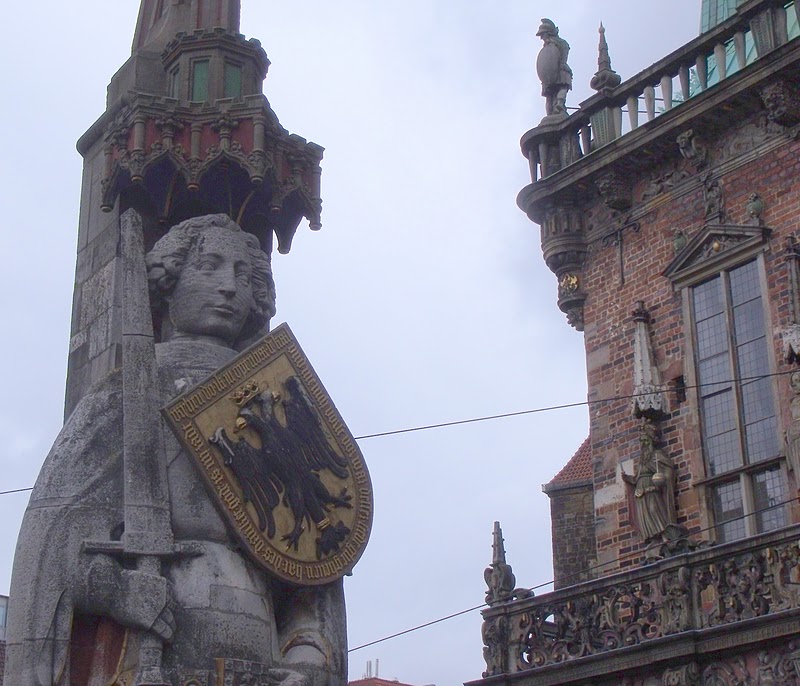
Ancient heroes, Roland and Charlemagne are both deployed like mascots in some kind of legendary sponsorship of the city. In neither instance could I tie up just what the actual connections were. But there is a splendid statue of Roland in the main square, encompassed in the Unesco heritage site that also embraces the Rathaus.


 The wealth here is to do with successful trading and the locals were wise and adventurous; taking a lead in trading with the New World trade almost before it was mapped. Something like 70% of all German wine passes through Bremen, some of it reaches the extensive cellars beneath the Rathaus, which contains a much loved restaurant with a vast wine list and a blocked up staircase that once lead straight to the council chamber in order to provide liquid refreshment. The food is excellent all over the city, heavy on both meat and fish, wonderful thick soups and sauces, my kind of eating. I made sure I only drank wine that was German right through the visit. I did avoid the many kebab houses, as ubiquitous as McDonalds.


There is a very lively arts scene here, including classical concerts seemingly at least a couple of nights a week. I was very fortunate. I caught two. First of all: a Wagner, Strauss and Shostakovitch concert by the visiting Amsterdam Concertgebouw; Andris Nelsons conducted. Amazing sounds, marvellous music making, but has there ever been a more miserable symphonist than Shostakovitch? I am sure areas of the first two movements are scattered with the instruction, 'aural assault' and the Dutch players went balls-deep obeying it. At times the sheer volume was uncomfortable, but the committed playing pinned one to the seat.

Nelsons opened with the Wagner Reinzi Overture; which I find almost comical in its Lloyd Webber overuse of the main theme in the first half, then it goes all Rossini and ends like a Strauss Polka. Of course, it was played for all it was worth and was a real crowd pleaser. What followed was a marvelous 'Dance of the Seven Veils' from Strauss's opera Salome. It could have been more down and dirty, but it worked well, the layers of sound and detail were remarkable. The conductor was simply terrific and it was clear the orchestra totally enjoyed working with him. They watched him, very significant, and were very warm in aplauding him. Ironic that I travel to Bremen to hear him; when he is the principal conductor in Birmingham.....on getting home I made speedy arrangements to hear him locally. I don't remember the last time a musician excited me so much.


The second concert: (It would have been better had they been the other way round.), was the Bremen Orchestra: Strauss 4 Last Songs and Bruckner 4th. The local outfit is fine, but it was a big step away from the previous night. The Strauss was soupy with the strings too loud, submerging the woodwind and harp. The soprano Kristine Opolais, (wife to Andris Nelsons), was OK, she did not do anything wrong, but I did not connect with her singing, the crowd appreciated her enormously.


I did therefore wonder how the orchestra would manage all the very quiet string work in the first movement of the Bruckner 4th. It managed just fine; which made me wonder why the Strauss had been so clotted. The orchestra could not match the sheer quality, the bottom heavy sonority and sweet, sweeping strings of the Amsterdammers, but it was good.

Their chief conductor, Markus Poschner, whose platform manner was positively inexpressive up against Nelsons, had not found that way of making you listen through the Brucknerarian silences, they became merely absence of sound. Those silences are vital, like windows in a building. We ought to hear the silence as part of the grand scheme. He also let the first movement disintegrate in places, where it occasionally ground to a halt. 


All that makes it seem I did not enjoy it; but I did. Then the stroll with stop-offs through the open air winefest on the way to the hotel, yet more enjoyment and more music. Though not the umpah kind, a rock group playing to a full square of swaying, drinking and grinning folk.


One big selling point to Bremen is the Kunsthalle gallery. About a month before I landed, the Independent made a big splash about this major art venue. Seemingly, (Note that word 'seemingly'.), it has a first rate collection of Renaissance works. The building has just been been refurbished and extended. It was also to cost 18 Euros to get in. I kept it for the final full day. Blow me, it was free.....but it was also basically empty. Only one Renaissance work, a statue of Venus. She looks like part of a cut price S&M exhibition; confined inside a box and tied up. I am still not sure whether she was waiting to be decanted, or whether she was part of the sparse installation art that provided a bit of summat to look at, and disdain, in a couple of the large suites of echoing, empty rooms.

 I was one of several people who were stalking round looking at blank walls, striding through empty rooms and coming away puzzled. The 'art' we saw for free consisted of a miniature Venus de Milo with a close-up camera trained onto her face. Across the wide low podium was an upright death mask....no idea whose, sadly not the artist's I assume. Likewise, this had a small camera trained on it. Between the two sculptures two TV monitors sat facing one another. The two static heads gazed out from the screens directly into one another's eyes. Mind bogglingly facile. Presumably the regular collection will be hung in due course. The postcard shop provided insights into what I missed. The Indie needs to get its facts straight.


Carrying on out of town past the Kunsthalle you come to a bohemian area, lots of large wall paintings, boutiques, vegetarian restaurants spilling onto the pavements, small art galleries. Off this thoroughfare run some very charming tree lined streets with attractive 19th century houses. As you travel out along this street, pass the manikin of the bride hanging over a first floor balcony, pass the large roof line relief of Buddha and beyond Bohemia you encounter louche, from louche you arrive at positively seedy. But along that road to ruin there is this very relaxed cafe society ribbon that belays the misconception many of us have of the uptight Germans.


I encountered only friendliness and politeness. No stern voices or pushy or dismissive attitudes. I found people helpful and so many had some English and none bothered to mention The War. I wandered into a men's clothes shop. A woman assistant strolled over to me and in a very nice way let me know that there would be nothing in the shop to fit me; she looked me up and down and said, "No, it is for big fat men." I raised my eyebrows and she smiled and confirmed, I did not qualify, not anything like fat enough. I was much cheered, I wear large or even extra large in England. Another blow to the German reputation for rectitude was a manhole cover in one square, drop a coin down a slot in it and it emits loud farm animal noises. 


 Just outside the splendid palace-like rail station is another newly refurbished museum. Let's call this rag-bag an ethnographic museum. I wandered this building outnumbered by the staff. A fascinating miscellany from preserved fish to oriental jewellery, bits of factory machinery and writings of immigrants; all brightly but confusingly displayed. Several of the staff were keen to chat to me: you can only look at those African tribal totems for so long before you need to interact. Again, English fluidly spoken and I was made to feel welcome, invited to photograph what I liked without using flash. 


Walking away into town, you cross the canal and see a large windmill on silted-up land. The city walls were flattened after Napoleon had invaded. He did not pull them down, but the locals thereafter saw no purpose in them and by removing them, they instead produced a narrow, long park that runs along to the river. Water and shipping have been vital here in the cohesion and prosperity of the city. A city that feels very much at one with itself, a thriving air about it, but not grasping, no hard sell anywhere. I was told that Autumn had arrived along with me. Winters round the Baltic can be severe, thus the agective; Baltic. I noticed one painting from around the 1920s where ice breakers were being used on the river. It is vital here that The Show Must Go On. Trade is lifeblood and cannot be impeded by the mere, mean, moodiness of Mother Nature. 


Next stop Poland.......Napoleon swept through and interfered there too!